Does your child get frustrated when trying to sound out words?
Without the right blending techniques, they may be relying on guessing or using pictures to "read." Think about how confusing it must feel—those letters just floating around in their mind without a real understanding of the sounds they make or how to connect them to read words. While guessing or looking at pictures might seem to work in the short term, these habits can block your child from becoming a confident, independent reader. Over time, this leads to even more frustration and a loss of confidence.
Now, imagine turning that frustration into excitement and pride with just a few simple strategies.
Research shows that early intervention in phonics and decoding can make a huge difference in a child's reading journey. In fact, a 2020 study from the Institute of Education Sciences found that children who received explicit phonics instruction, including blending practice, outperformed their peers by 19% in word recognition and 11% in comprehension by the end of second grade.
The National Reading Panel also found that teaching decoding in kindergarten and first grade significantly boosts reading outcomes. Students who receive systematic phonics instruction during these crucial years are much more likely to become proficient readers, with 90% achieving reading accuracy by third grade—compared to just 25% of their peers who didn’t receive this structured literacy instruction.
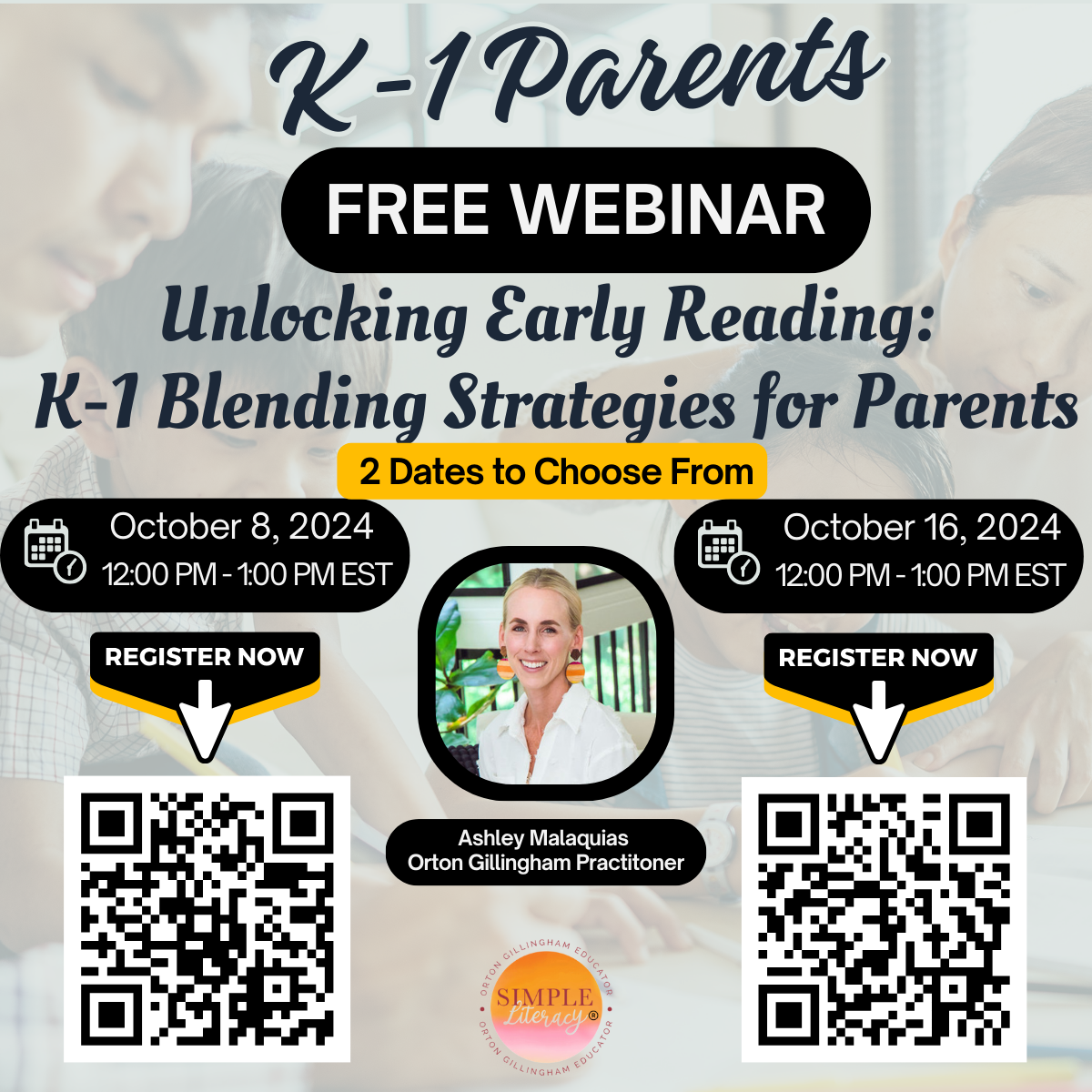
So, the next time you hear your little one proudly say "b-l-e-n-d... blend!" you’ll know you're witnessing the magic of blending in action. And the best part? You can be part of that journey! It’s as easy as reading together once you know the 3 simple steps for blending and the letter-sound combinations. I’ll teach both in my free webinar, Unlocking Early Reading: K-1 Blending Strategies for Parents. In just one hour, you'll gain the confidence to help your child build a foundation for lifelong reading success.
There are two dates to fit your schedule so you only need to register for one.
To register, click a link below or use the QR codes.
Tuesday, October 8, 2024, 12:00 p.m. EST
Wednesday, October 16, 2024, 12:00 p.m. EST
High-Frequency Word Hack

Did you ever wonder why so many question words in English—what, where, when, why—start with "wh"? The answer lies in the fascinating history of the English language. These words trace back to Proto-Indo-European roots, where the "k" or "kw" sound was commonly used to form questions. As Old English evolved, many of these question words started with "hw" (like hwæt for "what" and hwā for "who"). Over time, the letters flipped, giving us the familiar "wh" spelling we see today. Though pronunciation has shifted and in most modern dialects we pronounce "wh" like a simple "w," the historical spelling remains a nod to English’s ancient linguistic roots!